A Light That Knows How to Leave the House
How light meets darkness

(Based on an essay by Rav Menachem Froman in “Ten Li Zman”, drawing on the Mei HaShiloach of the Rebbe of Izbica)
In the wake of the horrific massacre in Sydney, many of us are left searching—not only for words, but for a way to respond to darkness without letting it pull us inward.
Hanukkah offers a familiar debate that quietly asks this same question.
Beit Shammai taught that on the first night, we light eight candles and then decrease. Beit Hillel taught that we begin with one candle and add another each night. We follow Beit Hillel.
On the surface, this is a disagreement about numbers. But Rav Menachem Froman, drawing on the Mei HaShiloach of the Rebbe of Izbica, explains that this is really a disagreement about how light meets darkness.
Beit Shammai emphasizes refinement and contraction—clarifying a pure, singular light from within the darkness. Beit Hillel insists on expansion: adding light night after night, allowing it to push outward until the darkness itself is transformed.
The Mei HaShiloach describes these as two kinds of light: particular light and general light. Particular light is focused and contained. It belongs to specific people, times, and places. It is the light of inner clarity, faith, and conviction—the light we naturally protect, especially in moments of fear or shock.
But there is also a broader light: a general light, one meant to spread outward and reshape the world itself. Rav Froman emphasizes that the movement from private light to public light—from inner truth to lived reality—is the spiritual work of Hanukkah.
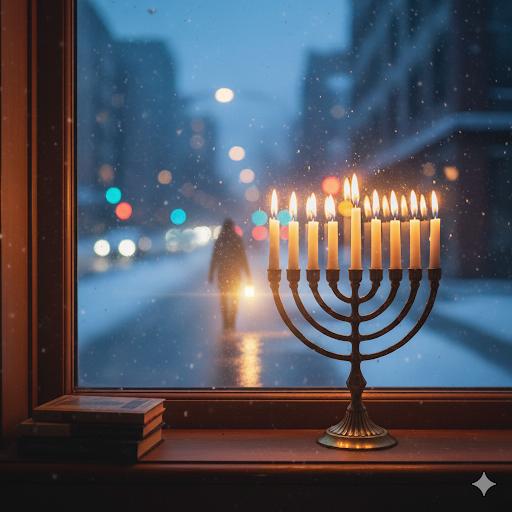
This is why the Hanukkah candles are not placed deep inside the home, but at the window, facing the street. Once, sacred light was centralized in the Temple. On Hanukkah, every home becomes a source of light, and every window becomes a threshold between inner faith and public space.
In moments like these, after acts of brutal violence, the instinct to withdraw is natural. But the Mei HaShiloach, as read by Rav Froman, asks something more demanding: not only to preserve our light, but to let it step into the public sphere without losing its integrity.
A candle in a window does not deny the night. It challenges it.
In the end, Hanukkah does not ask how dark the world has become.
It asks how light meets darkness.
Does light withdraw, waiting for the night to pass?
Or does it step forward—candle by candle—entering the darkness and changing the space it touches?
Hanukkah insists that light is not meant to remain protected. It is meant to be placed where it can be seen.
So as we light the candles this week, we might ask ourselves:
- Where in my life is my light still private?
- Where might it be ready to step outside?
- What is one place where I can let it spread?
Or more simply:
What would it look like to add one candle—not to myself, but to the street?
Postmortem: How AI Helped Shape This Essay
This piece was developed with the assistance of AI—not as a substitute for learning or thinking, but as a tool for clarifying, testing, and refining ideas.
The process began with an essay by Rav Menachem Froman, drawing on the Mei HaShiloach. I first used AI to OCR the original Hebrew text and produce an English translation. I did not need the translation in order to understand the text, but having it in English helped me step back from the source and begin the process of shaping it into an essay for a broader audience.
To check clarity and accuracy, I then gave the same Hebrew text to two different AI systems (Gemini 3.0 and ChatGPT 5.2) and compared their translations. The differences between them were instructive: seeing where each emphasized different nuances helped surface key conceptual tensions in the text, especially around ideas like contraction vs. expansion, private vs. public light, and refinement vs. diffusion. The alternative translation I shared later came from that comparison process.
From there, I used AI as a thinking partner rather than a writer. I tested structure (“Does this idea belong earlier or later?”), tone (“Is this too abstract for a newsletter?”), and emphasis (“What is the real challenge I want to leave the reader with?”). The back-and-forth helped sharpen language, reorder familiar material (like the Beit Shammai / Beit Hillel debate), and strengthen the ending so it functioned as a challenge rather than a summary.
At no point did AI supply the core ideas, sources, or moral framing. Those came from the texts themselves and from my own engagement with them. What AI did provide was speed, contrast, and clarity: the ability to move quickly from raw material to refined expression, and to see how an idea might land on a reader encountering it for the first time.
In that sense, AI functioned much like a study partner who asks good questions, offers drafts you can argue with, and helps you hear your own thinking more clearly. The responsibility for interpretation, emphasis, and judgment remained human throughout.
Rabbi Nate Fein
Nate is a Jewish educator, AI researcher, and currently head of customer success at Bavl.pro.