The Algorithm Needs a Shemitah
What an agricultural sabbatical law from Sinai has to say about systems that never stop.

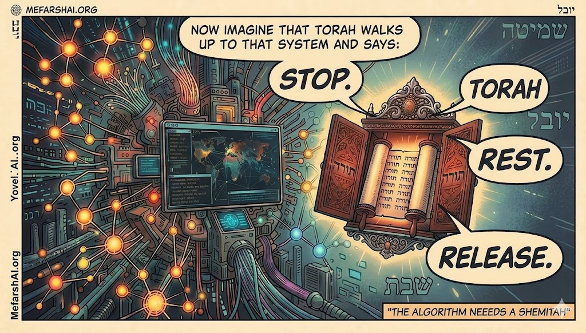
Imagine a system that never stops. It generates, responds, learns, adapts — around the clock, across time zones, without fatigue, without hesitation, without a single moment of deliberate stillness. It consumes text, images, code, behavior, attention, and memory. It promises abundance. It delivers output.
Now imagine the Torah walks up to that system and says: Stop. Rest. Release.
This is Parashat Behar.
📜 The Sinai Problem
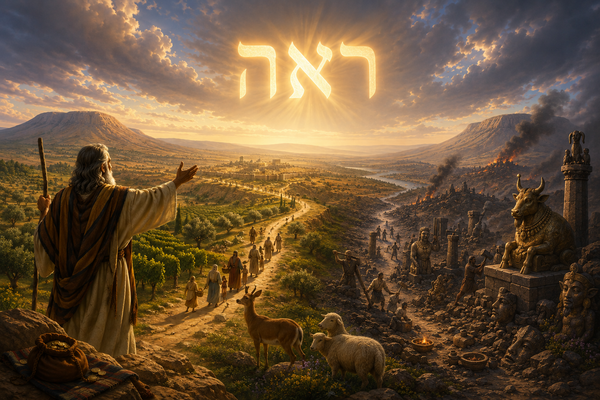
Parashat Behar opens with a curious editorial note: "Vayedaber Hashem el Moshe b'Har Sinai" — God spoke to Moses at Mount Sinai. (Vayikra 25:1)
Rashi, citing the Sifra, famously asks what bothered the rabbis for centuries: what is Shemitah doing at Sinai? 1 Why single out the agricultural sabbatical law as the one explicitly anchored to the giving of the Torah? The Sifra's answer: the same Divine encounter that authorized human creativity also, in the same breath, commanded human restraint.
The Netziv, in his Ha'amek Davar, adds a layer: the land of Israel is not merely a geographic location in this parasha — it is a b'rit, a covenantal relationship. 2 To work the land without ceasing is not just agricultural mismanagement; it’s a failure to understand the nature of the relationship.
The way in which AI is being built today - companies, tools, models, the average person making use of it all - is following the exact same failing pattern.
🌱 What Shemitah Actually Is — and Isn't
We tend to read Shemitah as an agricultural law, as in: let the field rest every seventh year, don't plant, don't prune, let the produce go ownerless. But the Rambam, in Hilchot Shemitah V'Yovel, situates Shemitah inside a much larger architecture of social and spiritual interruption. 3
Shemitah = Reset
The seventh year doesn't just let the land rest; it interrupts the whole system of ownership, labor, and productivity built up around the land. Creditors release debts (Devarim 15:2), the hierarchy between landowner and laborer loosens, and the shevi'it produce — whatever the land gives on its own — belongs to everyone equally. 4
The Sefer HaChinuch, explaining the reasoning behind Shemitah, says something remarkable: the mitzvah is designed to remind the farmer — and through the farmer, all of us — that the land does not ultimately belong to him. 5 You are a steward, not an owner. You hold the land in trust. Your six years of productivity do not grant you permanent dominion.
Today’s AI data and IP ownership challenges – who owns or has rights to AI model training content, or the output of any generated content (text, images, video, apps, etc) – are all murky and in play right now.
Behar was written for this moment.
🤖 A System Designed to Never Rest
AI, as currently architected, has no Shemitah reflex. AI doesn't say "I've been generating for six years, I should stop." Agents don’t say "enough." The recommendation algorithm does not say "let the field lie fallow." The optimization loop is not designed to interrupt itself. Rather, it’s designed to improve — and improvement, in this context, is measured by engagement, retention, clicks, and conversions, not by wisdom, restraint, or human dignity.
The Chazon Ish wrote that the spiritual danger of any technology lies not in what the tool does, but in what it trains us to expect. 6 A culture built around constant productivity trains us to treat stillness as waste. A culture built around infinite content trains us to treat silence as failure.
Shemitah is the Torah's counter-training program. The seventh year is not productive silence — it is intentional silence. It is not the absence of output – it is the presence of restraint. That distinction matters enormously when we think about what responsible AI could look like.
⚖️ Bechukotai: When the System Has No Covenant
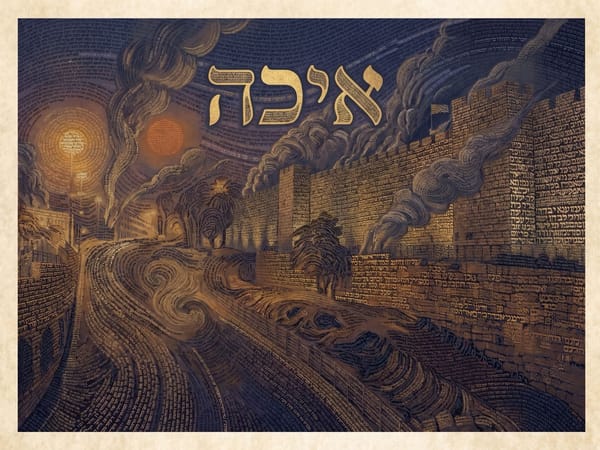
Then comes Bechukotai, and the temperature drops.
"Im bechukotai telechu" — if you walk in My statutes — the blessings will follow. Rain in its season. Produce from the earth. Peace in the land. (Vayikra 26:3–6) But "v'im lo tishme'u li" — if you do not listen — the system unravels. The rains fail. The harvests collapse. The land itself becomes hostile. (Vayikra 26:14–20)
The Ramban, in his commentary on these verses, insists that the curses are not arbitrary punishments. 7 They are the logical consequences of ignoring the structure of the covenant. The Torah is describing what happens to a society that treats the land — and by extension, the created world — as a resource to be extracted rather than a relationship to be honored.
Consider: what are the de facto curses of an AI system that rewards confidence over accuracy, engagement over truth, personalization over community, fluency over understanding?
- Noise instead of knowledge.
- Automation that removes human responsibility instead of augmenting human judgment.
- Systems that sort people into monetizable categories instead of honoring their complexity.
We would call that the naval birshut haTorah of the digital world — technically compliant, but spiritually hollow. 8 This is what Bechukotai teaches us for this moment. Not a supernatural punishment; a structural consequence of the covenant ignored.
🔓 Yovel: The Great Re-Alignment
Behar doesn't stop at Shemitah. It builds to Yovel — the Jubilee year, the fiftieth — when the Shemitah principles are amplified to their logical conclusion.
"Vekidashtem et shenat hachamishim shanah" — you shall sanctify the fiftieth year. (Vayikra 25:10) Ancestral lands return to their original families. Slaves go free. The entire apparatus of accumulated ownership and hierarchy is reset.
The Alshich HaKadosh reads Yovel as the Torah's acknowledgment that human systems, left to themselves, will always drift toward concentration — of land, of power, of wealth, of advantage. 9 Yovel is not punishment for that drift. It is the built-in correction. The covenant anticipated the problem and encoded the solution.
If Shemitah is a pause, then Yovel is a realignment.
In AI language — and I mean this seriously, not as a clever metaphor — Yovel is the question we are not asking often enough: Who has been trapped by the system we built? Who has lost agency? What needs to be returned? What must be made human again?
Who never consented to their writing being in the training data? Which communities never had a seat at the table when the values were baked in? Which workers were displaced by automation they never had a voice in designing? What has accumulated, invisibly, in the structure of the system — and when do we release it?
Yovel does not wait for the accumulation to become catastrophic. It interrupts the system before the drift becomes irreversible.
✨ What This Means for MefarshAI — and For Us
Here is the honest tension at the heart of what we're trying to build.
AI, used with genuine intention, can be a profound instrument of Torah access. It can open the gates of the Beit Midrash to people who were never taught they had a place there. It can surface a connection between a Rishon and a modern question that might otherwise take years to find. It can take a grieving family's recordings of their grandfather's Torah shiurim and turn them into something their grandchildren can learn from. That is not incidental. That is the whole point.
But Behar presses us to ask: Are we building systems that know how to rest? Are we building systems that treat the human beings they interact with as covenantal partners, not extractable resources? Are we designing for Yovel — for the moment when we return what was taken and restore what was diminished — or are we just optimizing for the next seven years?
The Sforno, commenting on "v'haaretz lo timacher litzmitatut" — the land shall not be sold in perpetuity — writes that this verse is the Torah's assertion that no human being can claim ultimate dominion over what God created. 10 The sale is always temporary. The ownership is always conditional. The covenant is always primary.
A holy technology must know when to stop. It must preserve room for silence, consent, attribution, dignity, and human judgment. It must make Torah more accessible without making wisdom feel automatic. It must deepen responsibility rather than outsource it.
The land needs rest. The worker needs freedom. The owner needs humility. The society needs reset.
And in our generation, the machine needs Shemitah.
Shabbat Shalom 🕯️
— Fred
Endnotes
- Rashi on Vayikra 25:1, citing Sifra, Behar 1:1 — the question of why Shemitah is explicitly anchored to Sinai, and the principle that all mitzvot were given at Sinai with their details. Sefaria: Vayikra 25:1
- Netziv (Rabbi Naftali Tzvi Yehuda Berlin), Ha'amek Davar on Vayikra 25:1 — the land as covenantal relationship rather than merely geographic territory. Sefaria: Ha'amek Davar
- Rambam, Mishneh Torah, Hilchot Shemitah V'Yovel 1:1–2 — the structure of Shemitah as a system of social and spiritual interruption. Sefaria: Hilchot Shemitah V'Yovel
- The release of debts in the seventh year (shemitat kesafim) derives from Devarim 15:2, developed extensively in Gittin 36a–37a, including Hillel's institution of pruzbul. Sefaria: Gittin 36a
- Sefer HaChinuch, Mitzvah 84 (Shemitat Karka) — the rationale for Shemitah as a reminder that the land belongs ultimately to God and the farmer is a steward. Sefaria: Sefer HaChinuch 84
- Chazon Ish (Rabbi Avraham Yeshaya Karelitz) — documented in Kovetz Igrot Chazon Ish and discussed in Emunah U'Bitachon. The specific formulation paraphrases the spirit of his broader critique of technology's effect on spiritual expectation. Sefaria: Emunah U'Bitachon
- Ramban on Vayikra 26:15 — the curses of Bechukotai as the structural consequences of covenantal breach, not arbitrary divine punishment. Sefaria: Ramban on Vayikra 26:15
- Ramban on Vayikra 19:2 — the concept of naval birshut haTorah, a person who violates the spirit of Torah while remaining technically within its letter. Sefaria: Ramban on Vayikra 19:2
- Alshich HaKadosh (Rabbi Moshe Alshich) on Vayikra 25:10 — Yovel as the Torah's built-in correction for the inevitable human drift toward accumulation and concentration of power. Sefaria: Alshich on Vayikra 25
- Sforno on Vayikra 25:23 — the theological assertion that no human being holds ultimate dominion over what God created. Sforno on Vayikra 25:23