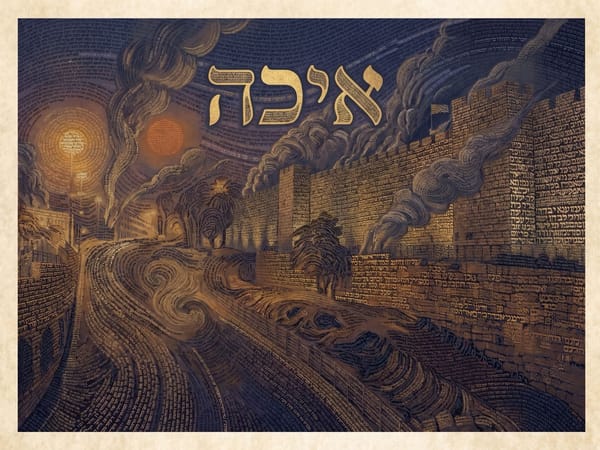
Ki Teitzei
700

Day 700 lands heavy. Families are still waiting. Young soldiers are still away from home. A whole people is living in a constant tension–release cycle. I don’t have a hot take; I went back to the opening of this week’s parsha and gathered the classic mefarshim end-to-end.
One note on tools: I pulled every pre-19th-century commentary on the beginning of Ki Teitzei from Sefaria, ran it through Bavl to create a single clear, 23-page, accurate, readable, and unified translation. Then I handed the document to ChatGPT-5 to compare, cluster, and pressure-test the ideas before drafting and iterating. Simple, and surprisingly effective.
…כִּֽי־תֵצֵ֥א לַמִּלְחָמָ֖ה עַל־אֹיְבֶ֑יךָ
When you shall go to war against your enemies….
The mefarshim keep circling the same premise: two fronts. There are many enemies outside, and one decisive adversary inside. The grammar nudges you there—plural “enemies,” but then a singular “He will give him into your hand.” One Kli-Yakar strand reads that as two targets—the “external enemy” and the inner accuser in danger—and says one of them falls first, “certainly the evil inclination.” If the inner general stays standing, any outer win starts to spoil.
Ben Ish Ḥai (Aderet Eliyahu) sketches the same picture with different ink: there’s a “general above,” and when the one above falls, the one below follows. This is the kind of thing that through habit should become practice, not a metaphysical idea alone: before trying to fix anything “out there,” ask what needs to fall “upstream” in ourselves.
That’s precisely where Or HaChaim goes: even when things go your way, let your eyes see “that it is Hashem who gave them into your hand, not by your own strength and power.” That’s not piety for the back page; it’s a live intention audit we can run before acting or posting. Why am I doing this? Who am I crediting? If I get this, what kind of person will that make me tomorrow?
Then the text turns to something deeply practical: cool the heat before you decide.
Ralbag reads yefat to’ar as moral engineering under pressure—give the yetzer some space so “its fervor may cool”—and he points out that the Torah removes costume, adds time (a full month), and raises the dignity floor (no selling, no abuse) so fantasy can melt and the person in front of you reappear. Not prohibition, not indulgence—permission wrapped in friction.
Rabbeinu Baḥya explains why the choreography works: our “heart and eyes” are the two messengers that pull the rest of us along. The ritual isn’t humiliation; it’s rewiring—less spectacle for the eyes, more time for the heart to judge. Another habit to build: if I change what my eyes consume and give my heart minutes to catch up, my choices get better.
How can we lessen the inner friction? It might not be glamorous, but it rings so true: stop lashon-hara. The Kli-Yakar reframes “when you go out”: fight outside, but inside the camp, make peace non-negotiable. “Guard against evil speech… when there is no peace among the fighters, they are defeated… ‘specifically against your enemies… not against your friends.’” You can feel how current that is. If the inner camp frays—homes, shuls, WhatsApp threads—nothing else we care about can hold.
Thread it together and the parsha shows us a way to carry all these days that doesn’t harden us: keep intention clean, slow the heat, protect dignity in the middle of the mess, guard what the eyes amplify so the heart can lead, and pull lashon-hara out of circulation so the “inside” doesn’t crack while the “outside” strains.
Everything is in Hashem’s hands - but maybe our renewed tefillot, acts of kindness, and love to each other could be the tipping point that finally frees the remaining hostages and ends this war.
Shabbat Shalom
-Dave
TL;DR — What we can do right now
- Name the inner front daily. Treat the singular “he will give him” as your first adversary to subdue—the yetzer. (Kli-Yakar cluster: one falls first, “certainly the evil inclination.”)
- Intention audit. Before a hard conversation or a public post, puncture kochi ve’otzem yadi: “not by your own strength and power” (Or HaChaim).
- Insert cooling before choosing. Run Ralbag’s thermostat: add time, remove glamour, raise dignity so fervor can cool.
- Eyes & heart hygiene. Reduce inputs that inflame the “two messengers”—heart and eyes (Rabbeinu Baḥya).
- Lashon-hara ceasefire. Make “inside the camp” a peace zone: no slander, no faction. “When there is no peace among the fighters, they are defeated.”
- Hold the upper→lower link. Keep the “general above” (aim, humility, dignity) aligned so the result below doesn’t deform (Aderet Eliyahu).
Behind the AI curtain
I grabbed all the pre-19th-century mefarshim on the opening of Ki Teitzei from Sefaria, translated the whole set with Bavl into one clear, uniform voice, and then fed it to GPT-5 for layered analysis.
- Why Bavl first? A single, unified, accurate, and consistent translation removes noise, allowing the ideas to align. See bavl.pro and my earlier post, Introducing Bavl, for how it works and why it doesn’t hallucinate, or get lost in longer texts like general chatbots.
What GPT-5 actually did for me here:
- Theme clustering: surfaced convergences (permission-as-friction; intention-as-variable; heart/eyes circuit) and honest disagreements.
- Signal tracing: tracked the plural→singular grammar and how different mefarshim leverage it.
- Context lenses: grouped takes by author/time/place to see what each era emphasizes.
- Tensions map: flagged where readings pull apart (concession vs rehabilitation) without flattening either side.
- Quote-first drafting: built the narrative around short pull-quotes, so the mefarshim stay the stars.
TL:DR: Bavl gave me one clean text; ChatGPT-5 helped me see the picture at once. AI doesn’t replace — it amplifies, makes more efficient, connects dots, opens doors, and is beginning to make more impossible things possible.