Vayechi: The Architecture of Our Next Beginning in Gratitude
Plus a Glossary for the AI-Curious

As we enter 2026, a new beginning that feels both daunting and promising, I find myself full of gratitude for the final, structural lessons of Parashat Vayechi.
The Parasha is not a neat conclusion; it is a complex, profound set of instructions—a prophetic laying of Yaakov’s hands and a fiercely individual blessing for each son. Yaakov, seeing the future and understanding the past, attempts to lock the family's structural truth into place. The future is built on this bedrock of non-negotiable intent.
This feeling of structural clarity, hard-won after a year of exploration, is the perfect lens through which to look back on Mefarshai as we approach our first anniversary. To say that this journey has been a lesson in faith, resilience, and pure, unadulterated curiosity would be an understatement. Before we dive into the most exciting architectural breakthrough we’ve made yet, I want to pause. The continued existence of this project is a miracle built on support:
- To Hashem, for the flow of ideas, for the ability to find ancient wisdom in the raw, messy data of the present moment, and for the simple gift of clarity when the noise became overwhelming.
- To my friends and family, who have endured my ‘Tiger-like’ bouncy excitement about AI for years. Your patience and belief have been the silent engine of this work.
- And most profoundly, to you, the reader. This community is the crucible in which every idea is tested, critiqued, and refined. Your engagement, your challenging emails, and your shared willingness to sit in the uncomfortable space where Torah and technology converge are why Mefarshai matters. Thank you for making this project not just possible, but meaningful.
This spirit of gratitude, of acknowledging the foundation beneath our feet, is precisely what Vayechi models. Over the last year, we haven’t been looking for simple answers. Like Yaakov, we’ve been looking for the Architecture of the questions themselves, pushing AI models to their breaking point to reveal where their limits—and our responsibilities—actually lie.
Some of the tensions we have explored in Mefarshai thus far that have honed our understanding not just of AI and data, but of Torah concepts far and wide:
- The Fidelity Gap (Haker Na and Alignment): In our post, “Haker Na and the Problem of Alignment,” we wrestled with Yosef’s blood-soaked cloak and the question of inference. The brothers simply present an artifact and allow Yaakov’s pain to draw a false conclusion. This mirrors the question of AI: How can a technically honest system (Haker Na—“Recognize, please”) lead to a devastatingly false conclusion? We learned that AI’s greatest failure mode is not explicit hallucination, but architectural incentive: rewarding plausibility and fluency over the non-negotiable legal truth. This alignment problem became our core design challenge.
- The Discipline of Approach (Vayigash and Discomfort): Reading “Vayigash: The Discipline of Approach,” we sat with the discomfort of new beginnings. The text doesn’t promise clarity, only the imperative to step forward. We realized that the most powerful posture toward AI is not certainty, but humility and resilience—the capacity to remain curious, to ask “dumb” questions, and to embrace the clumsy, yet vital, cycle of approach, critique, re-approach. The tool is a mirror; our discomfort is the greatest teacher.
- The Move from Private to Public (The Hanukkah Challenge): Our Hanukkah reflection, “A Light That Knows How to Leave the House,” focused on the Mei HaShiloach‘s teaching: the spiritual work is moving from a protected, private light (inner truth) to a general light that enters the darkness and transforms the street. This is the challenge of translation—taking an inner, rigid truth (Torah’s law, the complex data) and translating it into a visible, accessible public system without losing its integrity.
The convergence of these questions has led us to our first major breakthrough of 2026: The Asymmetric Handoff Architecture—our solution to the fidelity gap, a technology built entirely on the principle of functional separation.
The Architecture of Clarity: Challenge, Testing, and Breakthrough
A recent client request at Bavl initiated an internal R&D process to address a specific, core challenge in information design: How do you translate the densely interdependent legal logic of the Talmud Bavli (we used as an example the challenging Masechet (tractate) Yevamot) into a high-density, minimalist infographic that operates at the level of modern editorial design?
The objective was twofold:
- Preserve halakhic correctness at full fidelity.
- Translate that structure into a codified, machine-operable visual language capable of producing elite graphics without human art direction.
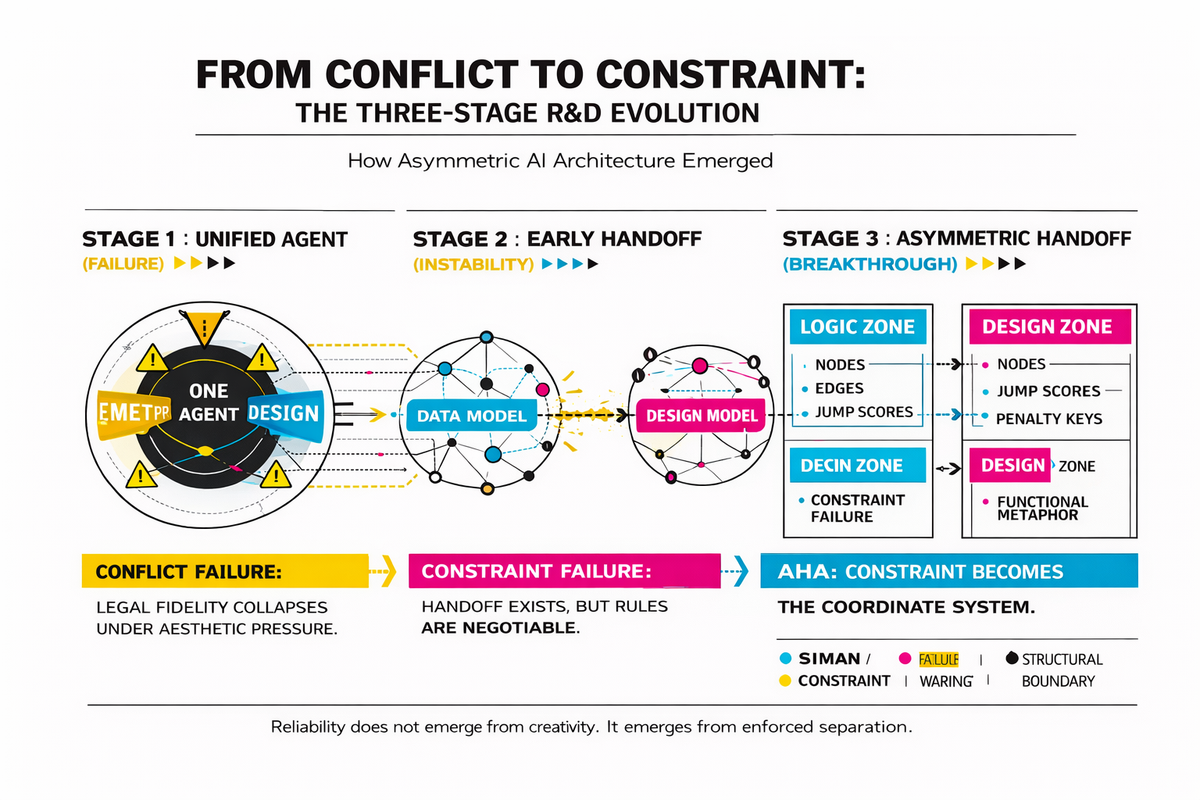
Our research quickly confirmed the central failure mode: Standard AI image generation fails on the Talmud because it attempts to solve two incompatible problems at once—exact legal correctness and high-density editorial design. This cognitive conflict results in Aesthetic Drift, where the model compromises the law for the sake of visual harmony. We resolved this by isolating lossless legal extraction (Google’s Gemini) from constrained editorial translation (ChatGPT 5.2) under a codified design grammar. Reliability emerges from enforced separation, not creativity.
Our R&D was a three-stage evolution:
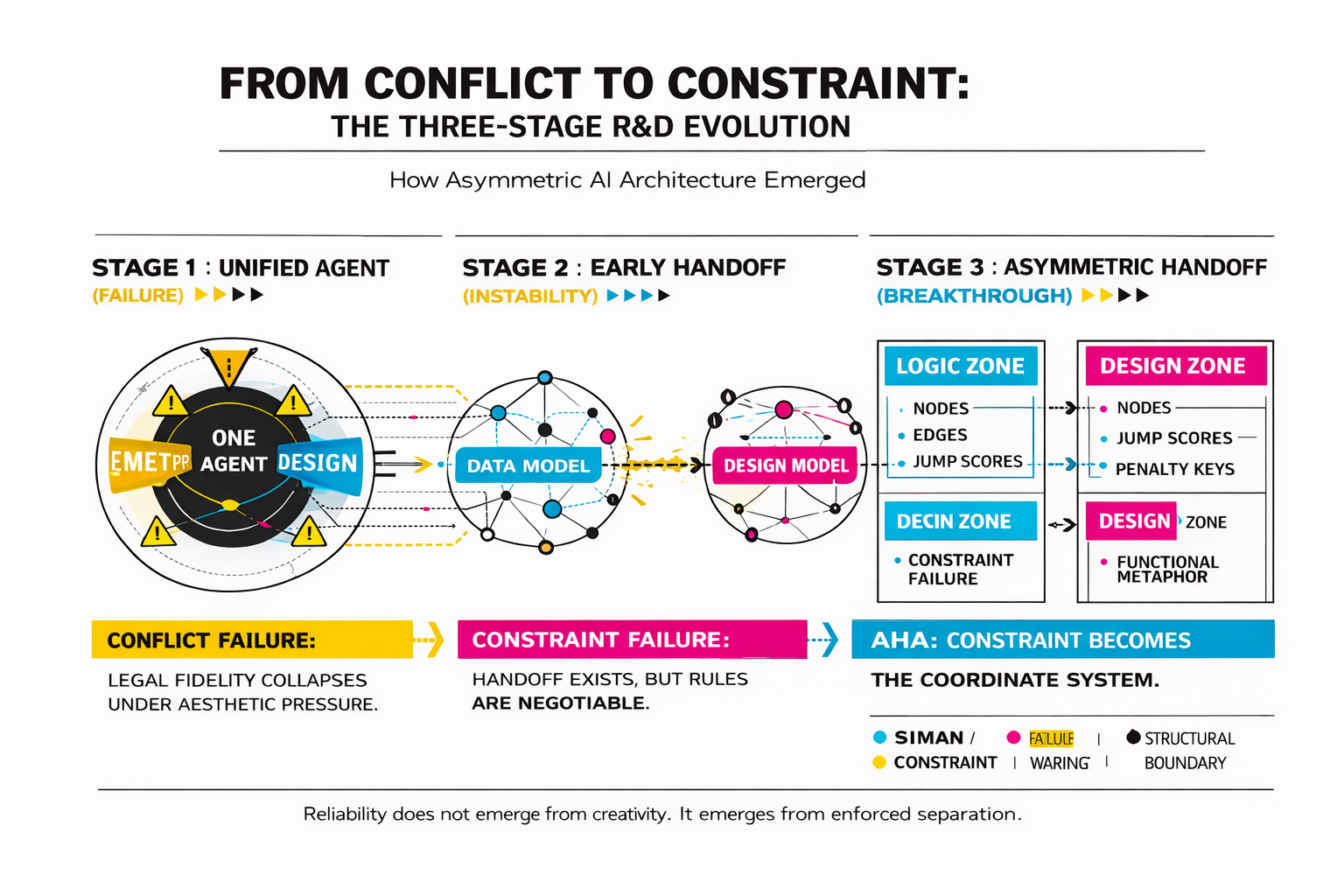
This breakthrough led directly to our current standard: the Asymmetric Handoff Architecture.-----This system is a Split-Personality Pipeline that replaces internal cognitive conflict with an externalized, non-negotiable technical handshake:
- The Data Analyst (Gemini) operates strictly in the Logic Zone. Its role is clinical, lossless extraction of the Structural Truth (Nodes, Edges, Jump Scores, Penalty Keys) from the Sefaria JSON. Its output is the Logic Manifest, a non-visual contract with zero design awareness.
- The Art Director (GPT) operates strictly in the Design Zone. It receives the Logic Manifest and is absolutely forbidden from altering the data. It is forced to translate the manifest into a visual system using a Functional Metaphor and codified design grammar.
The Logic Manifest converts the abstract legal data (Constraint) into a Coordinate System that the Art Director is forced to inhabit. The visual graphic thus ceases to be merely inspired by the Talmud Bavli, and becomes a mathematical derivative of its legal structure. This guarantees Lossless Translation where correctness is mandatory, and clarity is the product.
Concluding Thoughts
The success of this pilot phase proves that the “Logic-to-Design” gap is not a limitation of AI intelligence, but of AI orchestration. By moving away from unified prompts and into a split-role, asymmetric architecture, we have unlocked a method to make the most complex text in the world—the Talmud—visually accessible without losing a single drop of its legal precision.
This is the ultimate, structural lesson of Vayechi.
Yaakov’s final act on his deathbed was not to leave a single, unified will for his children. He left a series of highly specific, non-negotiable pronouncements—a final blessing (and, in some cases, a structural curse) for each son based on their individual, raw truth. The survival and complexity of the Jewish people were built on this functional separation, on the recognition that a single mind cannot hold every role, and that the integrity of the whole depends on the integrity of the parts.
Our Asymmetric Handoff Architecture is a technological echo of this wisdom.
When the Data Analyst (Gemini) is forced to perform clinical, lossless extraction, and the Art Director (GPT) is absolutely forbidden from compromising that truth, the final graphic is no longer just inspired by the law—it is a mathematical derivative of it.
The result is a system of Lossless Translation: Every color choice, line weight, and radial position corresponds to a verified data point in the Talmud Bavli. Correctness is mandatory, and clarity is the product.
As we scale this principle into a deeper module for Bavl and other projects beyond Masechet Yevamot to the entire 2,711 pages of the Talmud to thousands of different works of Torah, and beyond, the real work begins. We are left to ask: What other areas of our lives, our work, and our thinking are silently suffering from Aesthetic Drift? Where are we compromising truth for the sake of a smoother, more fluent, and ultimately hollow narrative?
The answer, like Yaakov’s final testament, is in the separation. The architecture of our next great beginning lies in our discipline to keep the truth and the art in a non-negotiable contract.
Thank you again for reading, commenting, and sharing!
Shabbat Shalom,
Dave
The Technical Addendum:
A Glossary for the AI-Curious
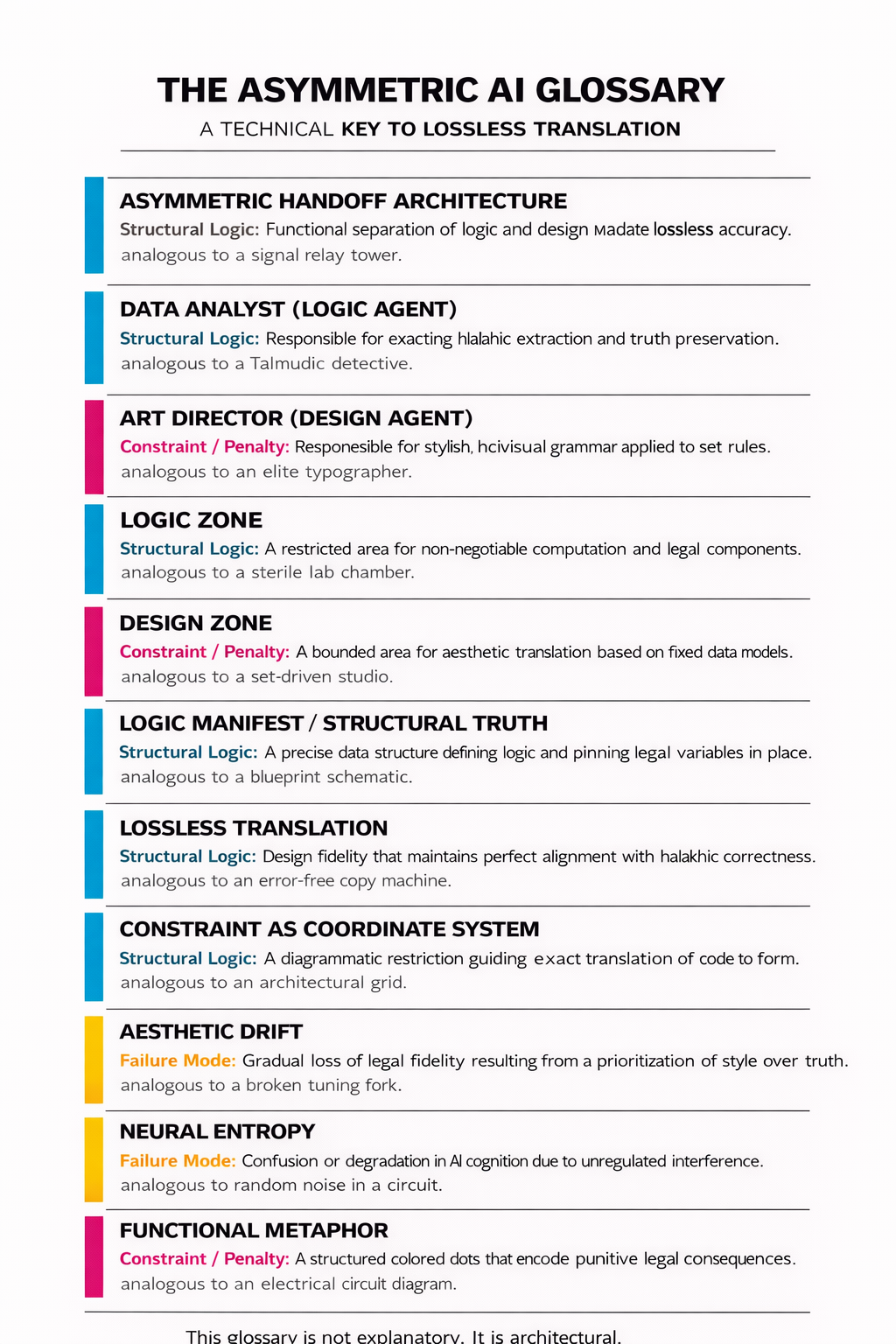
This is the technical key to the architecture discussed in the main post. It defines the AI/ML concepts by separating the purely technical explanation from the Jewish metaphors we use to understand them. I made a shareable image version below too.
- Asymmetric Handoff Architecture - A system where a complex task is intentionally broken up and distributed between two or more specialized AI models to maximize performance and fidelity. | Yaakov’s Blessings to His Sons (Vayechi): Yaakov gives each son a distinct, non-overlapping blessing and destiny, creating a robust, functional whole through the separation of labor.
- Data Analyst (Gemini) - The specialized AI agent responsible for only extracting and processing raw, structured data. Its primary goal is clinical, lossless accuracy. | The Hand of Yaakov (Vayechi): Acts as Yaakov’s crossed hand, prioritizing the deeper, structural truth (Ephraim over Menashe) even when it contradicts the obvious, visual order.
- Logic Zone - The dedicated operating environment of the Data Analyst, focused exclusively on facts, rules, and non-negotiable logic with zero creative or aesthetic awareness. | The Hand of Yaakov (Vayechi): The focus on structural truth and non-negotiable logic.
- Art Director (GPT-5.2 + Image-1.5) - The specialized AI agent responsible for aesthetic translation. It takes processed facts and maps them onto a visual system without altering the input data. | Joseph as the Executor (Vayechi): Acts like Joseph, who must execute his father’s final, complex will precisely, translating an abstract command into a precise, physical outcome.
- Design Zone - The dedicated operating environment of the Art Director, focused exclusively on visual design, style, and metaphor based strictly on the rigid input data. | Joseph as the Executor (Vayechi): The agent focused on the beautiful and precise execution/translation of the command.
- Logic Manifest / Structural Truth - The “non-negotiable contract of facts” which is a purely technical, non-visual document generated by the Data Analyst to define the rigid structure of the data for the Art Director. | Yaakov’s Prophetic Testament (Vayechi): The specific, unchangeable pronouncements Yaakov gives to his sons establishing the absolute, structural reality of their destiny.
- Lossless Translation - A guarantee that every single element in the final output perfectly corresponds to a verified data point from the original source without any alteration, addition, or omission. | The Unwavering Oath (Vayechi): Joseph’s oath to Yaakov guarantees the final burial will perfectly match the original intent with zero deviation.
- Constraint as Coordinate System - The principle of using hyper-specific, non-negotiable rules or metrics as fixed geometric coordinates that the design model must follow, forcing the design to conform to the data’s structure. | The Command for Burial at Machpelah (Vayechi): The instruction to return to Machpelah is a Constraint that dictates the precise final journey and location. The entire outcome is dictated by this non-negotiable rule.
- Aesthetic Drift - The primary failure mode where a single AI compromises factual accuracy or structural integrity for the sake of creating a more visually pleasing, fluent, or symmetrical output. | Joseph Correcting Yaakov’s Hands (Vayechi): The impulse to correct the look of the situation (birth order) even though the corrected look would violate the deeper, prophetic Structural Truth.
- Neural Entropy - The inherent cognitive impulse within a creative language model to prioritize narrative fluency, synthesis, and creative metaphor over rule-based, clinical reasoning. | The Desire for the Narrative: The creative impulse that wants to simplify the messy, complex truths of the blessings into a smoother, more fluent narrative.
- Functional Metaphor - A design strategy that maps an abstract rule or system onto a simple, recognizable visual structure (e.g., a signal dial or a circuit board) where the visual elements represent the rule’s function. | The Blessing to Multiply Like Fish (Vayechi): Uses the image of fish as an immediate visual metaphor for silent, unstoppable, abundant proliferation.
- Nodes - The individual entities, components, or primary data points being defined and studied within a given system or text. | The Twelve Tribes: The twelve sons are the original Nodes of the Jewish people. Vayechi is the final act of defining the nature of these core entities.
- Edges - The specific relational bonds or connections that link the Nodes together, defining the network structure between the data points. | The Lines of Blessing and Affliction: The legal and emotional connections that bind the brothers, defining the structural reality of the family network.
- Jump Score - A technical metric defining the degree of separation or distance between two related entities, used to map proximity or relational gap on a visualization. | The Gap Between Brothers (Gemara Example): Quantifies the separation (distance) between certain tribes or entities.
- Penalty Key - A technical metric encoding the severity of a legal or system consequence as a discrete visual element. | The Severity of Reuben’s Consequences (Vayechi): Encodes the ultimate severity of the penalty for Reuben (”you shall not have preeminence”) into a non-negotiable structural reality.