Vayigash: The Discipline of Approach
Discomfort FTW

TL;DR
This week, as we read Parashat Vayigash and bring 2025 to a close, I found myself sitting with the idea of approach — of what it means to step forward without knowing how things will turn out. The first part of this piece is a Torah reflection on discomfort, beginnings, and the strange, unresolved moment we’re in with AI. The second part pulls back the curtain and shows how this reflection came together: the prompts, revisions, tools, images, and judgment calls that shaped it. Read on for the Torah; stay for a glimpse of how humans and AI can learn to think — and approach — together.
Reflection
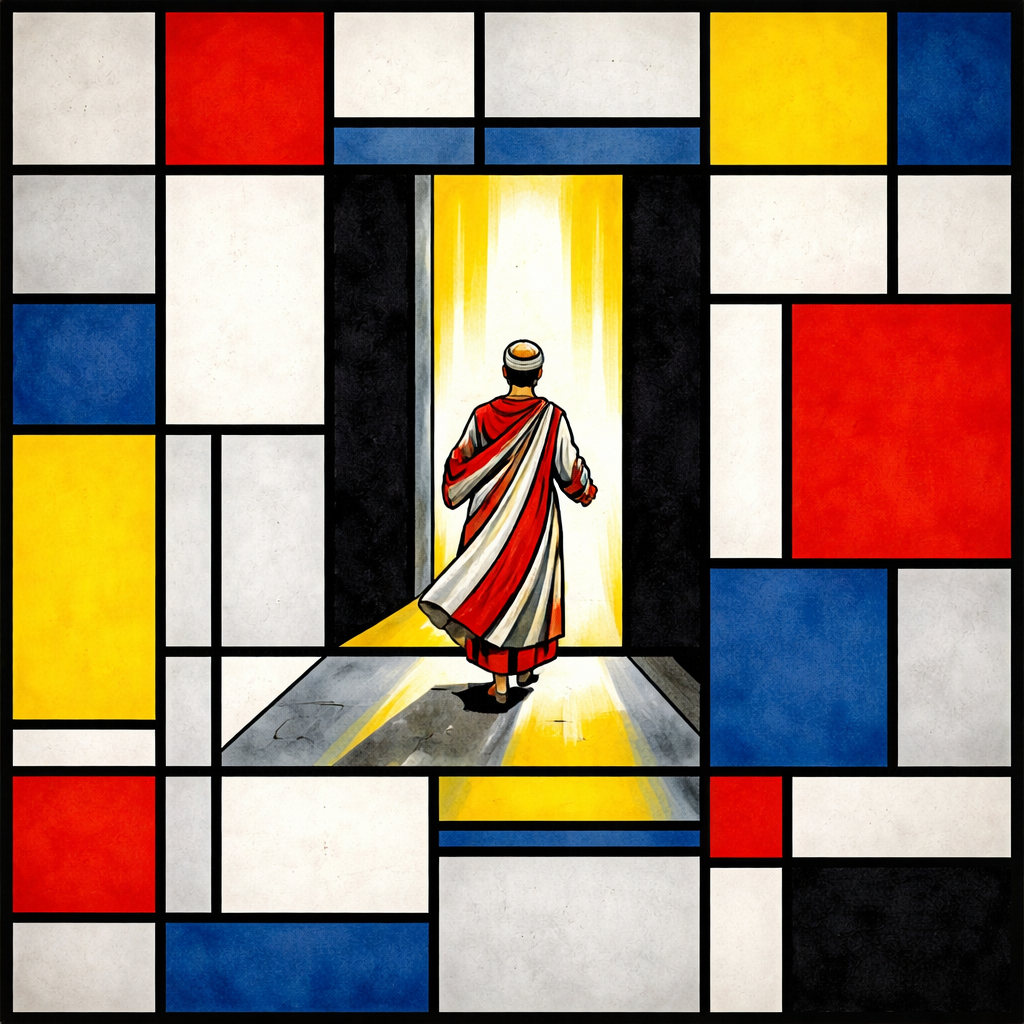
He steps forward without knowing how it will end.
Without knowing whether this moment will bring reconciliation or disaster.
Only knowing that not approaching is no longer an option.
There’s a phrase we repeat easily, but rarely sit with long enough:
Kol hatchalot kashot — all beginnings are hard.
Not because they are poorly designed.
Because they force us to remain present without clarity.
AI feels like that kind of beginning.
Not just a new tool, but a new posture toward thinking itself — how questions are asked, how knowledge is assembled, how decisions are shaped. And that is deeply uncomfortable. We don’t yet know how much good or harm this shift will cause. We only know that change will come regardless. That, too, is something Jewish history understands well.
Torah doesn’t ask us for certainty in moments like this.
It asks us to approach.
To sit with discomfort without fleeing it.
To ask questions — even unsophisticated ones — without embarrassment.
To think out loud with others, human and artificial alike, because learning only happens when it’s allowed to be clumsy.
I’ve had to teach myself not to confuse not knowing with being unprepared. Asking “dumb” questions — of people or of AI — isn’t a weakness. It’s a discipline. How else do we learn?
None of this works in isolation. Discomfort is only survivable when it’s shared — when there are people around us to push against ideas, to reflect them, to help us feel safe enough to remain present even when the ground is shifting.
And there is always another side to discomfort.
Another perspective.
A new idea.
A pivot. A pause.
A failure. A breakthrough.
Life and death.
Sickness and health.
Vayigash reminds us that the approach itself is an act of faith — not faith in outcomes, but faith in process. In a relationship. In the belief that staying present matters, even when the future is unresolved.
As 2025 comes to a close, I’m grateful not for certainty, but for resilience — for the capacity to approach rather than retreat, to remain curious rather than defensive, and to innovate with heart while standing firmly inside the tension.
That, too, is a beginning.
Technical Addendum:
What Happened Behind the Curtain
This post went through two materially different AI-assisted drafts. The differences weren’t cosmetic — they reflect distinct modeling choices, tool usage, and human–AI interaction patterns.
Below is a concise breakdown.
Phase 1 (v1): Conceptual Draft — Internal Reasoning Only
Goal: Explore Vayigash as a metaphor for discomfort and AI, in a reflective Torah voice.
Inputs
- Human prompt:
Torah (Vayigash), AI, discomfort, resilience, gratitude, communal voice - No external facts required initially
Models & Tools
- Language model: GPT-5.2 (reasoning + generation)
- Tools used: none
- Knowledge source: internal training data only
(Torah narratives, Jewish language registers, AI discourse patterns)
Model Behavior
- Generated content using internal semantic associations
Optimized for:
- Conceptual coherence
- Thematic resonance
- Controlled ambiguity
Avoided:
- Citations
- Dates
- Tool calls
- Images
Outcome
- Strong idea alignment
- Correct tone
- But: surface-level from an AI-process perspective
(no visible evidence of research, tooling, or constraint resolution)
Phase 2 (v2): Instrumented Draft —
Research + Tools + Iteration
Goal: Produce a version that demonstrates AI cognition, not just describes it — and arrives at a final post aligned with MefarshAI voice.
Added Inputs
Explicit human request to:
- Show real AI judgment calls
- Use native tools
- Access outside research
- Expose differences between drafts
Models & Tools Used
- Language model: GPT-5.2 (generation + meta-reasoning)
Web tool:
- Verified parasha, date, and narrative framing (Hebcal, Chabad)
Image generation:
- GPT-Image-1.5
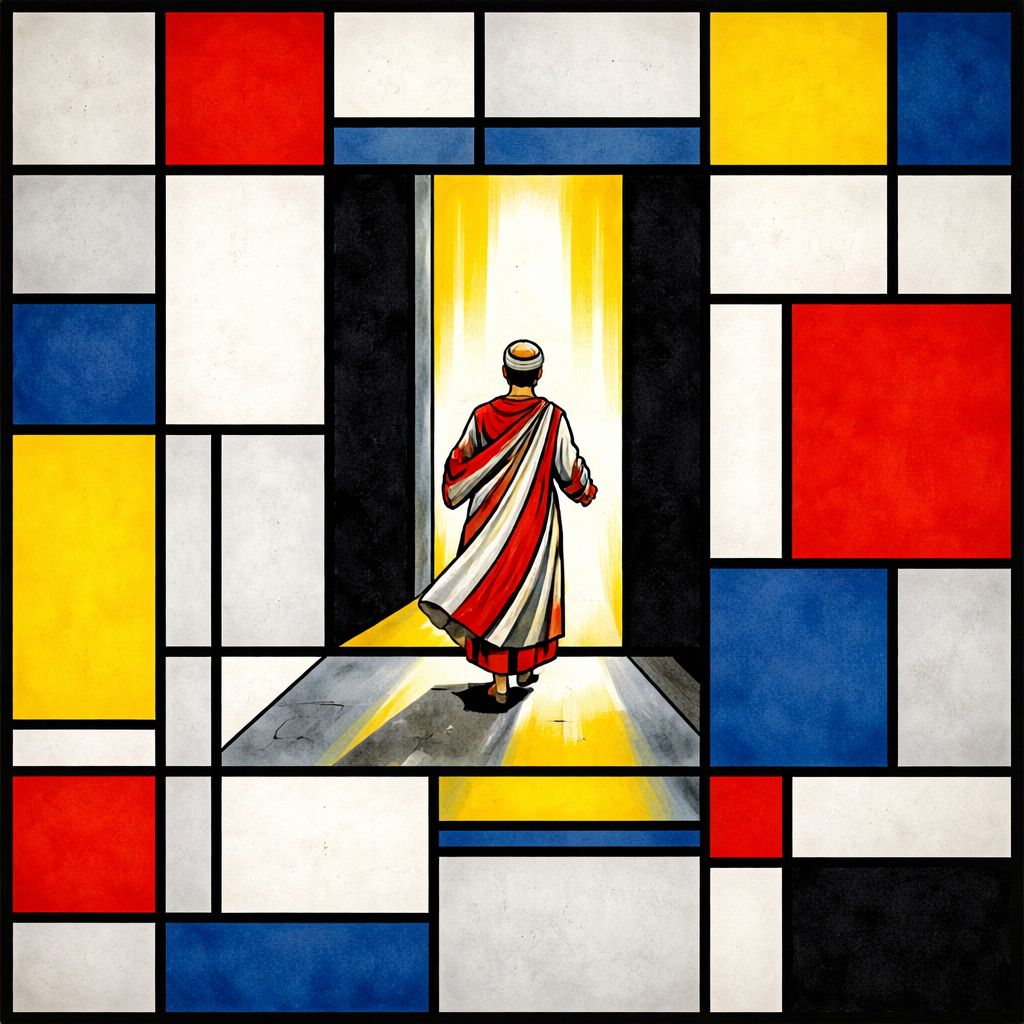
- Generated two custom images (portrait + 16:9)
- Iterative feedback loop:
Human critique → AI revision → human refinement
Model Behavior Shift
Aspectv1v2Knowledge sourceInternal onlyInternal + external verificationAI roleWriterWriter + analyst + documentarianStructureImplicitExplicitly explainedImagesConceptual onlyGenerated with intentMeta-awarenessHiddenExposed
Key AI Judgments in v2
- When to introduce tools vs. rely on internal knowledge
- What not to cite (mefarshim, psukim) to preserve voice
How to reframe AI not as “answer engine” but as:
- Pattern holder
- Question amplifier
- Discomfort stabilizer
- When to stop optimizing and lock the final draft
Human–AI Cycle (Actual, Not Idealized)
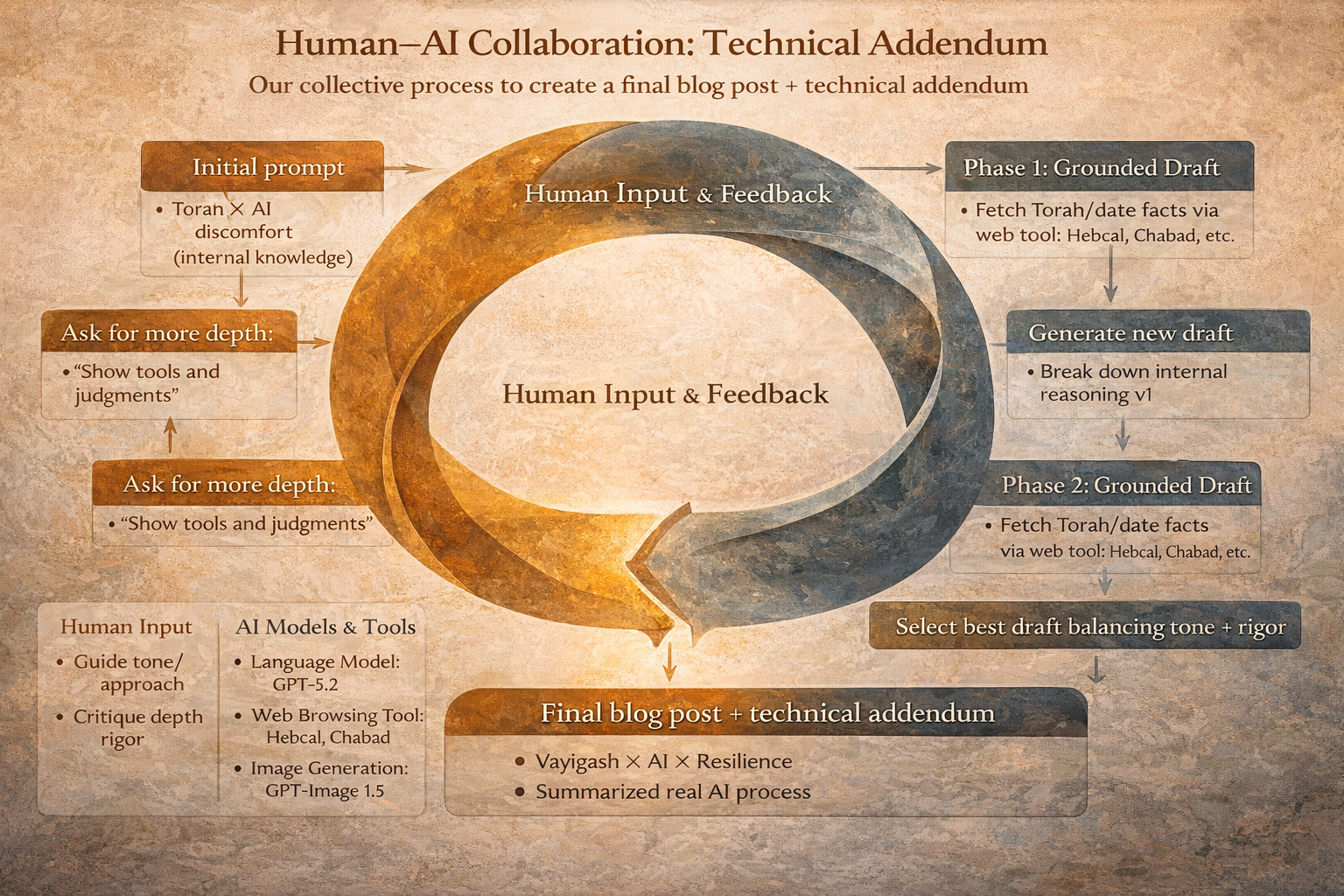
Human: Initial concept (Torah × AI × discomfort)
   ↓
AI: Draft v1 (internal reasoning only)
   ↓
Human: Push for depth and transparency
   ↓
AI: Meta-analysis + explanation of choices
   ↓
Human: Request tool usage + outside research
   ↓
AI: Draft v2 (research, images, documentation)
   ↓
Human: Select final post + request clean addendum
   ↓
AI: This document
What This Demonstrates
AI is not most powerful when it “knows things,” but when it can:
- Track constraints across iterations
- Hold unresolved tension without collapsing it
- Switch roles: generator → critic → documentarian
The quality of output was driven less by the model upgrade than by:
- Human insistence on discomfort
- Iterative tightening of intent
- Explicit permission to show the machinery
That process — approach, critique, re-approach — is the real through-line from Vayigash to AI work.