Eikev or: What Happens After You Get What You Wanted


There's a strange little word that gives this week's parsha its name. Eikev usually gets translated as "because" — as in, "and it will come to pass, because you listen to these laws, that God will keep the covenant." But the same root means "heel." Rashi picks up on this: it isn't just "because," it's the stuff we tread on. The small print. The commandments a person is tempted to trample underfoot, precisely because they seem minor compared to the big, dramatic ones.
That double meaning is the whole parsha in miniature. Eikev is not about the mitzvot that are hard to ignore — the ones that announce themselves. It's about what happens in the unremarkable middle of a well-fed, comfortable life, once the crisis is over and nobody's watching that closely anymore.
The danger isn't hunger. It's satisfaction.
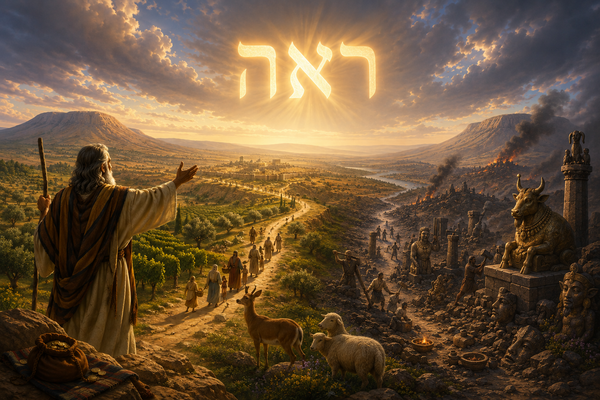
Moshe spends most of Eikev previewing a problem the generation in the desert doesn't have yet: abundance. Until now, it's been, "What are we going to do, we're starving in the wilderness!" Now it's going to be, "What will you do when you've built good houses, and your herds have multiplied, and your silver and gold have multiplied, and your heart grows haughty?" (Devarim 8:12–14, paraphrased). The warning isn't about poverty corrupting people. It's about ease corrupting people — the specific moment when everything is going fine and you start to believe you built it yourself.
This is also where Moshe delivers the line everyone knows out of context: it's not that bread doesn't matter, it's that a person can't live on bread alone — because God let the nation get hungry in the desert and then fed them with manna, food they'd never seen before, specifically so they'd learn that provision comes from somewhere beyond their own effort (8:3). The manna wasn't a punishment for the hunger. It was a lesson embedded inside a physical need. Get the physical thing, but don't let getting it erase where it came from.
The Shema's second paragraph is in this parsha
Here's what's easy to miss: the second paragraph of the Shema — the one that ties rainfall and harvest directly to spiritual faithfulness, the one we say every day without necessarily registering how blunt it is — is sitting right here in Eikev (11:13–21). Serve God with full heart, and the rain comes in its season, the grain and wine and oil come in, the cattle eat their fill. Turn aside to serve other gods, and the sky shuts, the ground stops producing, and the good land God is giving you stops giving anything back.
Most of religious life gets talked about in terms of long-term or afterlife consequence. This passage refuses that framing. It says the spiritual and the physical are not two separate ledgers being reconciled somewhere far away — they're the same ledger. What you orient your inner life toward shows up in whether the fields produce. Eikev is the parsha that will not let you split "spiritual health" and "material life" into two unrelated departments.
Our generation's manna
It's worth asking what plays the role of "bread" for us right now — the physical provision so total, so uncannily well-timed, that it risks teaching exactly the wrong lesson if we're not paying attention. For a growing number of people, that thing is AI.
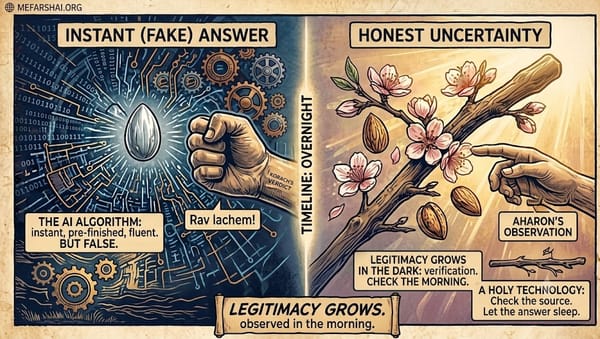
It's a strange kind of manna. It answers before you've finished forming the question. It drafts the email, remembers the context, does the first pass of the thinking so you don't have to. Used well, it's not so different from any tool that frees up capacity for something more essential — the way a good harvest frees you up to actually be present at your own table instead of worrying about your next meal. But the same warning Moshe gives about houses and herds applies with unsettling precision here: the risk isn't that the tool fails you. It's that it works, consistently, and you quietly start to believe the competence is coming from somewhere other than where it's actually coming from — and stop noticing what it's replacing in you along the way. Attention that used to have to stretch. Memory that used to have to hold things. The slow, effortful version of a task that was doing something to you, not just producing an output for you.
That's not a reason to reject the tool. Eikev doesn't tell the nation to refuse the good land, the full silo, the multiplying flock. It tells them to eat, and then remember — to actively resist the amnesia that abundance makes so easy. The mitzvah is not poverty. The mitzvah is memory in the middle of plenty.
Writing it down is the actual work
There's one more detail in this section worth sitting with. Right after the warning about forgetting, Moshe doesn't just say "remember harder." He gives a physical, external mechanism: bind these words on your arm, place them between your eyes, write them on the doorposts of your house. Not a feeling you're supposed to sustain through willpower. A written, load-bearing structure you build into the architecture of ordinary life, precisely because you can't trust your own memory to hold the value once things are going well.
That's a strangely modern insight. Anyone who has tried to keep a fast-moving, capable system — human or otherwise — aligned with a set of values discovers the same thing pretty quickly: good intentions don't survive contact with convenience. What survives is whatever got written down clearly enough, and placed somewhere visible enough, that drift gets caught before it becomes forgetting. A value that lives only in your head, unexamined, will lose to a shortcut that lives in front of you every day. The doorpost isn't decoration. It's the thing standing between "I remember God gave me this" and "my own strength got me this" — precisely at the moment when it would be easiest not to notice the difference.
We are, all of us, currently deciding what the doorposts look like for a technology that is very good at meeting physical and practical needs, and much quieter about what it might be replacing while it does. Eikev doesn't answer that question for us. But it insists, forcefully, that the answer can't just be "we'll remember." It has to be written somewhere we'll actually see it — every day, at the door, on the way in and on the way out.
Shabbat Shalom!
- Moshe
Dr. Moshe Glasser is the Managing Editor of Mefarshai, and the "Keeper of the English Language" at Gently Ventures, Jerry Press, and Bavl. Moshe lives in Israel with his wife and kids.