Re'eh: Seeing What You Want to See
I asked an AI what it could do for my business. It gave me a beautifully confident answer. That confidence was the first warning sign — and it's also, it turns out, the subject of this week's parsha.
The Confidence Trap
I asked an AI what it could do for my business. It gave me a beautifully confident answer. That confidence was the first warning sign — and it's also, it turns out, the subject of this week's parsha.
Sight Beyond Sight
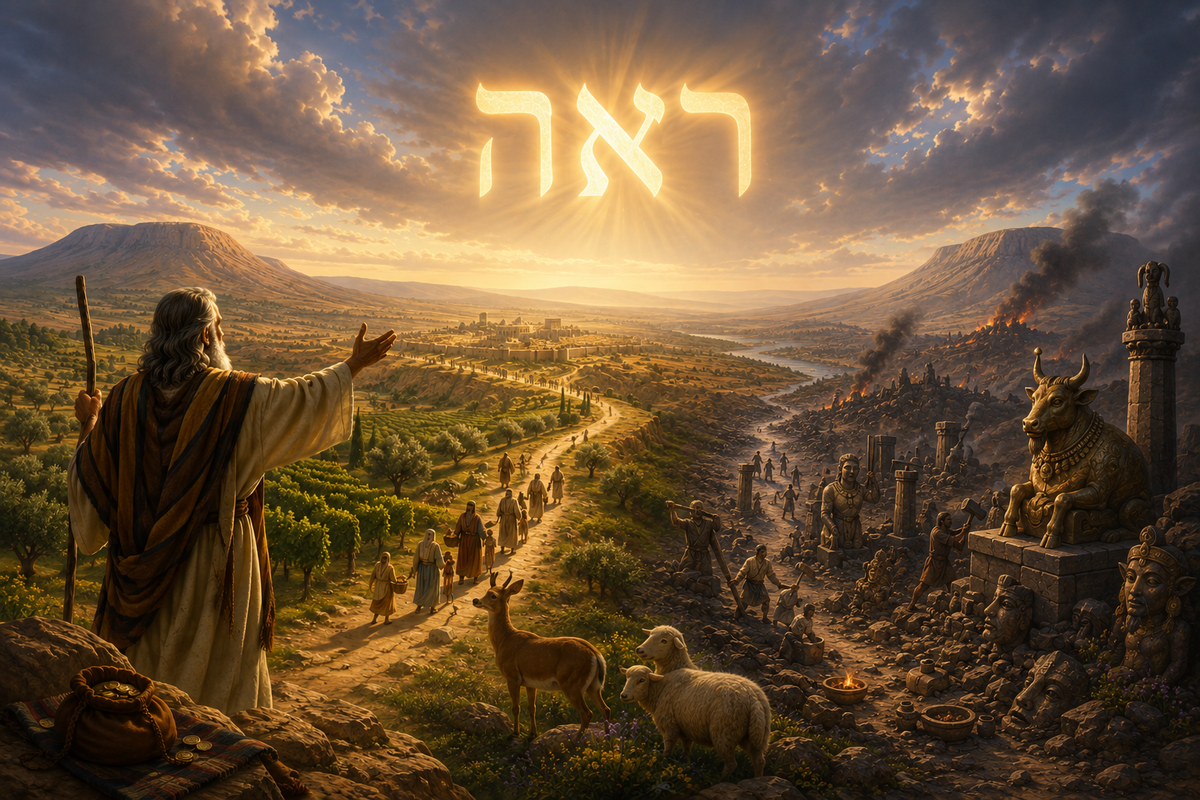
Parshas Re'eh opens with a command to see: "Re'eh, anochi nosein lifneichem hayom bracha uklalah" — See, I set before you today a blessing and a curse. It's on ddd verb — blessings and curses aren't things you look at, they're things you live through, often only in hindsight. Yet Moshe insists on sight, right at the outset of a parsha that will spend most of its time worrying about exactly what people choose to look at, and where they choose to build.
A few verses later comes the warning that frames the whole parsha: when you enter the land, don't worship the way the nations there worship — "al kol har gavoha," on every high mountain, under every leafy tree. Don't do, Moshe says, as we are doing here today, each person doing what is right in his own eyes. Instead, wait for "hamakom asher yivchar Hashem" — the place that Hashem will choose. Not a place anyone can name yet. Not a hilltop you can pick because it's tall and impressive and already there. A place that history hasn't revealed. Bnei Yisrael won't actually stand at that place for another few hundred years, once David consolidates a kingdom and Shlomo finishes a Temple.
The Place Where I Belong
That's the whole tension in miniature: the high mountain versus the unnamed place. One you can see right now — it's tall, it's visible from a distance, you can climb it this afternoon and start building. The other place, the real place, you can't see at all. It exists only as a promise, unfolding somewhere inside a future you don't control and can't verify.
Idolatry, in this reading, isn't really about having the wrong theology. It's about which kind of stability you're willing to trust. An idol is available. You carve it, you can touch it, you can watch it stand still and stolid, and that stillness feels like reliability in a world that otherwise gives you none. The high mountain is a shortcut to certainty. The true Mikdash asks you to hold your certainty in reserve — to trust a shape in history you cannot yet see the outline of. "Seeing what you want to see" is choosing the mountain that's already there over the place that hasn't been revealed, because the first one is so much easier to have faith in.
The More Things Change . . .
Here's where it gets more interesting than "idolatry bad, monotheism good." Once the place is revealed and the Mikdash is built, the Torah doesn't ask people to abandon the physical altogether. Korbanos are still blood, smoke, an animal on a fire — about as tangible as religious practice gets. The Rambam, in the Moreh Nevuchim, explains why: people who had grown up in a world where every nation worshipped through sacrifice couldn't be asked to leap straight to something wordless and invisible. So Hashem redirected the instinct rather than erasing it. Take the impulse that built altars on every high mountain, and channel it toward the one place He chose. You can no longer build altars on your own mountain; they can only be on My mountain. The physical act stays; only its address changes.
But the Rambam doesn't treat that as the final destination. Prayer — tefillah, words alone, no altar, no location required, no animal, nothing you can point to — is described by him as a higher order of avodah than sacrifice. It's the same relationship in a more mature form: not the physical object standing in for the connection, but the connection itself, unmediated by anything you can see or hold. When the Mikdash fell, we didn't lose access to Hashem. We discovered that the visible infrastructure had never been the point. The invisible thing it had been protecting all along still worked.
A.I. Have Been to the Mountaintop
This is where I think about my own field. AI right now is a lot of high mountains. There is a visible, demonstrable, here-today capability: it drafts your email, summarizes your document, writes passable code. It's tall, it's already built, and you can climb it this afternoon. And there is a promised capability — genuine reasoning, reliable judgment, real autonomy — that we're told is coming, unfolding somewhere in a future none of us can fully see yet, no more visible right now than the site of the Mikdash was to Bnei Yisrael standing at the border of the land. It will arrive, as long as we have . . . faith?
The temptation is to worship the mountain because it's there. To take the tool's current, visible fluency — its confidence, its polish, its instant answers — and grant it the trust that should be reserved for something that has actually proven itself over time. That's not a critique of the technology. It's a critique of a very old habit, applied to a new object: mistaking available for reliable, mistaking what I can see right now for what deserves my faith. An idol never had to be false to be dangerous. It only had to be premature — trusted before it had earned it, worshipped because it was convenient to look at.
Certainly Uncertain
The real risk was never that idols demanded sacrifice. It's that they let you stop waiting. They let you resolve your uncertainty on your own schedule instead of history's. Re'eh's deepest instruction isn't "see correctly" — it's "notice what you're tempted to trust simply because it's in front of you, and ask whether it has actually earned that trust." The Rambam's ranking of prayer above sacrifice is the payoff of that discipline: the more mature your faith, the less it needs to be looking at something to believe in it.
AI's promise is a live test of that same muscle. Its current abilities are real, and worth using. But the thing worth believing in — worth building your stability on — has not yet revealed itself any more than the site of the Mikdash had revealed itself at the border of the land. Climbing the nearest high mountain because it's already there is not faith. It's just convenience wearing faith's clothes. The place that actually deserves to be trusted is usually still the one you can't see yet.
Shabbat Shalom!
- Moshe
Dr. Moshe Glasser is the Managing Editor of Mefarshai, and the "Keeper of the English Language" at Gently Ventures, Jerry Press, and Bavl. Moshe lives in Israel with his wife and kids.