The Staff That Had to Sleep On It

Parshat Korach, Rosh Chodesh Tamuz, and why the Torah keeps making us wait until morning to find out if something is true.
Mefarshai · Tamuz 5786
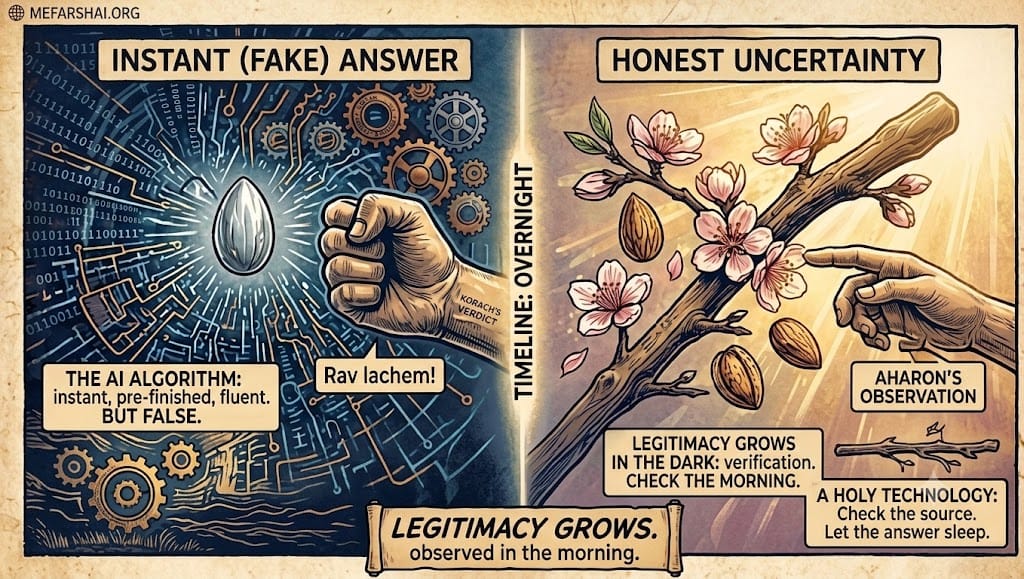
Ask an AI a hard question and watch what comes back. It doesn't hedge, doesn't pause, doesn't say "give me a minute to think this through." It produces a fluent, fully-formed, confident paragraph in about the time it takes you to glance at your phone — and that paragraph reads exactly the same whether it's correct or quietly making something up. Nothing about the tone, the formatting, or the speed tells you which one you're holding. The answer looks finished. Whether it actually is finished is a separate question entirely, and the text gives you no way to tell the two apart.
This is Parshat Korach. This, too, is Rosh Chodesh Tamuz.
📜 "Enough For You" — Korach's Instant Verdict
Korach's rebellion opens with a declaration, not an argument. He and his two hundred and fifty men gather against Moshe and Aharon and announce: "Rav lachem! Ki kol ha'eidah kulam kedoshim" — "Enough! The entire community, all of it, is holy — why do you raise yourselves above the congregation of Hashem?" (Bamidbar 16:3).1 Notice the shape of the claim. It isn't "let's discuss whether the hierarchy is fair." It's total, instant, and self-certifying: everyone is already holy, the matter is already settled, there is nothing left to test. It sounds, the moment it's spoken, like a finished thought.
Moshe's response is the tell. He doesn't argue back. He doesn't say "no, you're wrong." He says: fine — tomorrow, bring fire pans, and we'll see. A claim of total legitimacy, declared instantly, gets met not with a counter-declaration but with a test that takes time to run. The Mishnah later holds Korach's dispute up as the textbook example of machloket she'einah l'shem shamayim — a fight not conducted for the sake of Heaven — in deliberate contrast to Hillel and Shammai, whose disagreements were carried out through generations of process and still, somehow, both endure.2 The difference was never about who happened to be right. It was about whether either side was willing to let the truth take time to show itself.
🔥 Standing Between the Dead and the Living
The ground swallows Korach's company. Fire consumes the two hundred and fifty. And the next day, a plague breaks out among the people anyway, because a verdict — even a correct one, even a Divine one — doesn't automatically heal what broke. Moshe tells Aharon to take the ketores and run into the middle of the dying camp. Aharon does, and the Torah says simply: "vaya'amod bein hameitim u'vein hachayim, vateiatzar hamageifah" — "he stood between the dead and the living, and the plague was stayed" (Bamidbar 17:11–15).3
Rashi, on this scene, brings the famous image of Aharon physically seizing the Angel of Death and holding it in place against its will.4 That's worth sitting with. Whatever was going to fix this was never going to be a memo. It required a body inserted into the actual wound, standing exactly at the line between the casualties already taken and the people who might still be saved. Hillel, generations later, would describe this same Aharon as the man who was "oheiv shalom v'rodef shalom" — a lover and pursuer of peace (Avot 1:12).5 Pursuer, not announcer. The thing he was praised for took time and cost him something. It was not produced instantly, and it did not arrive pre-finished.
🌱 The Staff That Had to Sleep On It
God could have ended the question of legitimate authority by fiat — and, frankly, already had, several times over, in fire and earthquake. Instead, for the final word on who truly stands for Hashem, twelve staffs are collected, one per tribe, Aharon's name written on Levi's, and all twelve are left overnight in the Mishkan. Only in the morning does anyone check. And only Aharon's staff has budded, blossomed, and borne ripe almonds (Bamidbar 17:23).6
The mechanism is the point. Real legitimacy, in this story, isn't asserted — it's grown, observed, and verified after something has had time to actually happen in the dark, unwitnessed and un-announced. A claim that's true the moment it's spoken doesn't need a night to pass. A claim that needs a night to pass might still turn out to be true — but you don't get to skip the night to find out.
⏳ Rosh Chodesh Tamuz and the Month of the Premature Finish
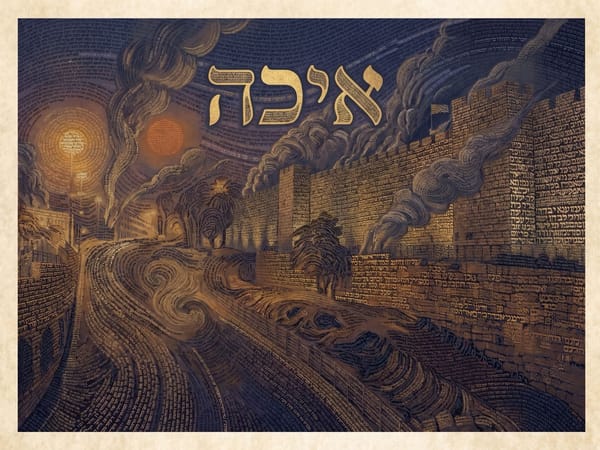
Rosh Chodesh Tamuz carries this same problem at the level of the calendar. The seventeenth of this month holds two of the Mishnah's five great calamities: the breaking of the first set of Tablets, and centuries later the Roman breach of Jerusalem's walls.7 Both are moments when something got declared finished — a relationship, a wall, a city's safety — before anyone had actually weathered what came next.
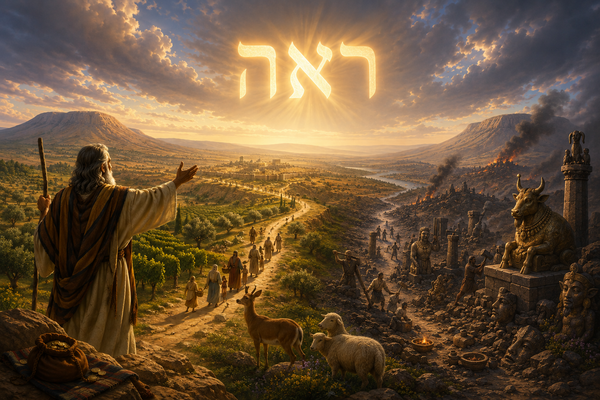
The Golden Calf belongs to this same month, and it's the clearest example in the whole Torah of the move this essay keeps circling. The people had been told Moshe would return at a certain time; the count ran long, the silence stretched past what they could sit with, and rather than wait through the unresolved middle, they built a finished god in a single day. Fully formed. No curing time. No night required. An answer that arrives instantly — even a false one — is easier to live with than honest uncertainty, which is exactly why it's so dangerous. Moshe came down the mountain to a camp that had already declared the matter settled, and the first thing he did, famously, was break the actual evidence that the relationship they'd just replaced had been real all along.
🤖 What That Has to Do With the Algorithm
Bring this back to where we started. An AI's confident paragraph is fluent the way Korach's claim was fluent, the way the calf was finished the moment the gold stopped pouring — no waiting required, no visible seams, no night that needed to pass before anyone could check. That fluency is not a flaw to be patched in the next model. It's the nature of language smoothed into a finished-sounding shape, and it will keep looking exactly as confident when it's wrong as when it's right.
The Torah's answer, across this whole parsha, is structural, not rhetorical: build in the night. Build in the body in the breach. Build in the test that takes time to run, and the staff that has to be checked in the morning rather than trusted in the evening it was planted. That's a useful habit to actually carry into how we use these tools — not to distrust every fluent answer on principle, but to treat fluency itself as exactly the kind of evidence it is: none. Go look at what actually grew overnight. Check the source. Let the answer sleep on it before you build on top of it.
✨ Closing
We are reading Korach in the same week we entered Tamuz, with the seventeenth of the month — and the slow walk to Tisha B'Av — three weeks out. A month that opens, calendar-wise, with a parsha that refuses to let a declaration substitute for a test, and that holds within it the original cautionary tale of a people who couldn't wait for the morning. Tamuz doesn't ask us to distrust every confident answer, every leader, every blossoming branch. It asks us to actually wait and check.
Shabbat Shalom 🕯️
— Fred
Fred Goldman is Managing Partner at Gently Ventures, (including bavl.pro + Jerrypress.com), father to eight awesome kids, and a serious Sefarim geek.
Endnotes
- Bamidbar 16:3 — Korach's declaration that the entire congregation is already holy. Sefaria: Numbers 16:3
- Mishnah Avot 5:17 — Korach's dispute as the paradigm example of machloket she'einah l'shem shamayim, contrasted with Hillel and Shammai. Sefaria: Pirkei Avot 5:17
- Bamidbar 17:11–15 — Aharon's ketores offering and standing between the dead and the living to stay the plague. Sefaria: Numbers 17:11-15
- Rashi on Bamidbar 17:13 — the Angel of Death seized and held in place against its will. Sefaria: Rashi on Numbers 17:13
- Mishnah Avot 1:12 — Hillel's description of Aharon as oheiv shalom v'rodef shalom, a lover and pursuer of peace. Sefaria: Pirkei Avot 1:12
- Bamidbar 17:23 — Aharon's staff found budded, blossomed, and bearing almonds the morning after the staffs were left in the Mishkan. Sefaria: Numbers 17:23
- Mishnah Taanit 4:6 — the five calamities associated with the Seventeenth of Tamuz, including the breaking of the first Tablets and the breach of Jerusalem's walls. Sefaria: Mishnah Taanit 4:6