The Red Heifer and the Talking Donkey

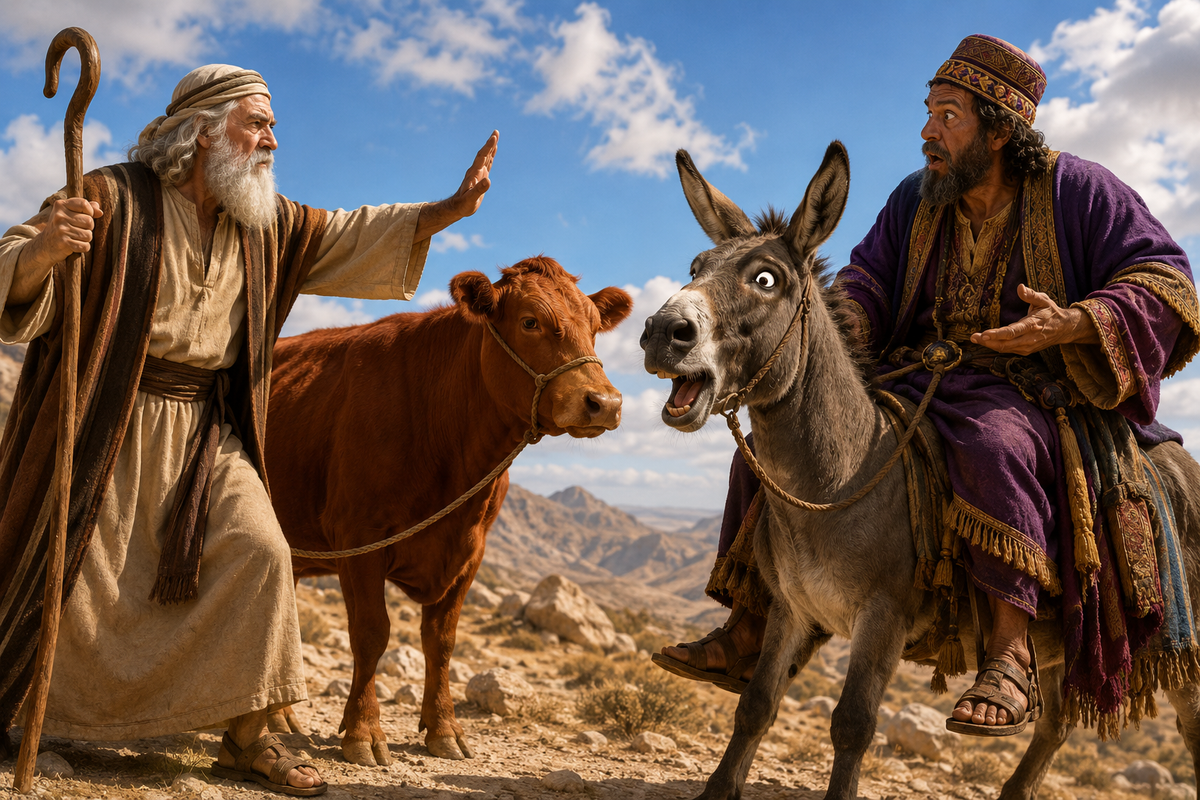
Why Chukat and Balak Live Together
Most years, you don’t read Parashat Chukat and Parashat Balak as two separate stories. You read them as one long parasha, back to back. And if you’ve ever sat in shul trying to follow the thread from one to the other, you’ve probably had the same reaction: What do these two have to do with each other?
Chukat opens with the strange, almost mystical law of the red heifer — a ritual so paradoxical that the Torah itself calls it a “chok,” a decree beyond human reason. It almost seems like the black box of an LLM — we don't know how or why it works; we just know that it generally gives us the result we want.
Then comes many other seemingly disparate events: the deaths of Miriam and Aharon, a water crisis, a copper serpent, and several battles. Balak, by contrast, is a geopolitical thriller: a foreign king hires a famous sorcerer to curse the Israelites, and the sorcerer’s donkey ends up talking more sense than he does.
Why are these events conducted as a single piece?
Death, and the Forces That Profit From It
One answer is that the calendar requires that we occasionally double up parshiot. However, it can’t be a chronological coincidence that these two were paired together.
Chukat is bracketed by mortality. It opens with a ritual for purifying someone who has touched a corpse. It closes with two of Israel’s central figures — Miriam, then Aharon — dying in the wilderness, and a generation realizing that the people who left Egypt will not be the people who enter the land. Death isn’t a subplot in Chukat. It’s the organizing fact of the parasha.
Balak opens with a different kind of threat to Israel’s survival — not natural mortality, but a deliberate, engineered attempt to destroy the nation through curse. Balak the king and Bilaam the prophet-for-hire aren’t swinging swords. They’re trying to use spiritual technology — blessing and curse — to erase a people from the outside. Balak continually asks why Bilaam can't just do what he needs — the continual plea of someone trying to get an AI prompt to spit out exactly what he wants. But every time, it seems to go wrong.
The Chok and the Curse: Two Things Reason Can’t Touch
There’s a sharper thematic thread here as well. Chukat is named for “chukim” — laws that defy rational justification. The red heifer purifies the impure and, in a famous paradox, renders the one who prepares it impure in turn. Commentators from the Midrash onward have leaned into this: some things are not meant to be understood, only obeyed.
Balak is, in its own way, a parasha about a different kind of irrationality: a curse that refuses to curse. Bilaam is a professional. He has a working relationship with blessing and curse as a craft. And the entire plot of the parasha is the spectacle of that craft failing — repeatedly, comically, against all of his experience and skill — because the words simply will not come out "wrong."
Put differently:
Chukat is about a law that doesn’t make sense and must be followed anyway.
Balak is about a curse that doesn’t work, no matter how precisely it’s aimed.
Both sides are seeking the precision of giving instructions to the tool and getting the desired output, but neither understands that this is not the whole story. There is a greater intelligence behind this.
Moshe and Bilaam: A Mirror the Sages Couldn’t Resist
There’s a long tradition of reading Bilaam as a dark mirror of Moshe. Both are described as unparalleled prophets of their respective nations. Both ascend a mountain to encounter God. The difference is that Moshe’s prophecy is in full alignment with what he’s instructed to say, while Bilaam’s prophecy “fights him” — he climbs each mountain intending to curse, and is overruled each time, until by the third attempt he’s stopped trying to fight it and simply lets the blessing through.
That contrast lands harder if you’ve just spent a parasha — Chukat — watching Moshe himself stumble. He strikes the rock instead of speaking to it. He loses his composure under pressure from the people. The two portions, taken together, offer two studies of leaders losing control of their own instrument: Moshe losing control of his temper at the rock, Bilaam losing control of his own mouth on the mountain. One failure costs Moshe entry into the land. The other failure, ironically, is what saves Bilaam from becoming the villain he set out to be.
The Inextricable Link
Bilaam was convinced that his powers of cursing and blessing were just a tool, bendable to his will whenever he wants. He thinks it's an LLM — with the right prompt, you can get whatever output you want. His donkey explains that he lacks control over even his own life, let alone the lives of the Jewish People. Moshe understands that Hashem's world doesn't work that way. The red heifer isn't some explicable tool that can be applied mathematically to create the desired result. It needs to be trusted at a higher spiritual level and embraced for the mystery it is. There's nothing generative about it.
Shabbat Shalom,
Moshe
Dr. Moshe Glasser is the Managing Editor of Mefarshai, and the "Keeper of the English Language" at Gently Ventures, Jerry Press, and Bavl. Moshe lives in Israel with his wife and kids.